
Inbound and Outbound Logistics in India: What 30 Years on the Road Teach You
Kushagra Bhargava
Close to 70% of India's domestic freight moves by road. Most of us never think about the trucks behind it, until a delivery is late or a shelf is empty.
So who keeps a factory fed through the night? What does it cost to keep a truck moving? And what kind of person builds a transport business that lasts three decades?
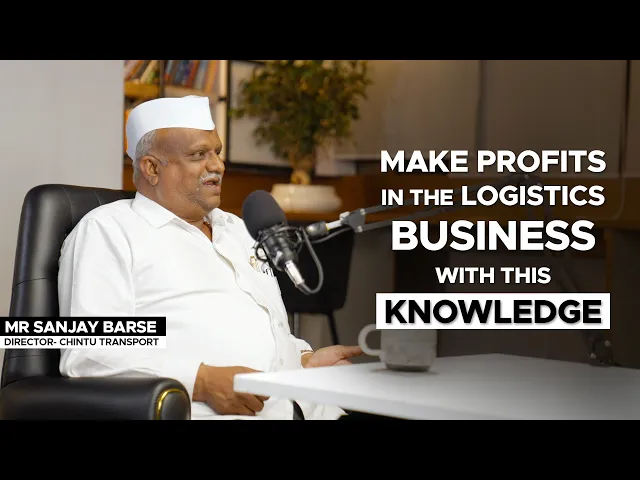
In Episode 1 of The Fuelling Pod, we sat down with Sanjay Barse, director of Chintu Transport, Pune. Here is what that conversation taught us about the industry.
Who is behind Chintu Transport?
So who keeps a factory fed through the night? What does it cost to keep a truck moving? And what kind of person builds a transport business that lasts three decades?
Sanjay Barse entered transport with no logistics background. He cleared the MPSC, chose business over a government job, and started on the loading floor at an auto plant in Pune. From there, he learned to drive, then learned to manage.
Chintu Transport began with one truck in 1996. Today it runs 225 trucks carrying industrial goods for some of India's largest manufacturers.
In Episode 1 of The Fuelling Pod, we sat down with Sanjay Barse, director of Chintu Transport, Pune. Here is what that conversation taught us about the industry.
That scale is rare. A study by IISD and IRADe found that 80% of truck operators in India own fewer than five trucks. Very few grow beyond that.
What does a transport company actually do?
At its core, a transport company connects factories. It works on both sides of production.
Inbound logistics brings raw material and components into a factory, timed to the production plan.
Outbound logistics takes finished goods out to the next plant, warehouse, dealer or customer.
Inbound | Outbound | |
What moves | Raw material and components | Finished goods and sub-assemblies |
Typical example | Parts from a vendor, timed to the assembly line | Engines moved from one plant to another |
What a delay costs | A stopped assembly line | A missed delivery and a penalty |
One truck often does both jobs. An engine leaving one plant is outbound for that plant and inbound for the next.
This work carries real weight in the economy. DPIIT and NCAER put India's logistics cost at 7.97% of GDP in 2023-24, and road freight is the largest part of it.
Why does trucking never stop?
A truck that stands still earns nothing. That is why logistics runs 365 days a year, 24 hours a day. When the rest of the country takes a holiday, transporters often get busier.
A truck rarely runs from A to B and back. It goes from one plant to another, picks up the next load, and keeps moving. Many contracts also charge a penalty for every hour a delivery is late.
The average truck in India covers only about 325 km a day, at an average speed of around 35 km per hour, according to CRISIL. So every hour lost to a breakdown, a check or a wait hurts.
Why are trucks getting bigger?
The simplest way to cut cost per tonne is to carry more per trip. One driver, one toll, one fuel tank, more cargo.
In Sanjay Barse's career, standard loads have grown from 10 tonnes to 40. Government rules have moved the same way. In 2018, MoRTH raised permitted vehicle weights, lifting a five-axle truck from 37 to 43.5 tonnes. The government said the change would raise carrying capacity by 20 to 25% and cut logistics cost by about 2%.
The smart operators load right up to the legal limit, and never beyond it.
Why is it so hard to find truck drivers?
Ask any transporter about their biggest problem, and most will say drivers.
Union Minister Nitin Gadkari has said India has only 75 drivers for every 100 trucks, a shortfall of about 22 lakh
TeamLease puts the ratio closer to 55 drivers per 100 trucks, leaving about 20 lakh trucks idle
MoRTH removed the minimum education requirement for transport licences in 2019 to widen the pool. The gap remains
Long stretches away from home, modest pay and low social status keep young people away. In the episode, he explains how his fleet finds drivers, and how changing the way drivers are paid changed how they work
Why are tyres the second-biggest cost?
After fuel, tyres are often the largest running cost for a fleet. A heavy truck can run on 22 tyres, and each one is expensive to replace.
The biggest enemy is wrong air pressure. When two tyres in a pair are at different pressures, one carries more load and wears out faster. Ignore a flat inner tyre, and you lose its pair too.
The data backs this up. The US EPA finds that tyres running 10 psi below the right pressure cut fuel economy by 0.5 to 1%. A US FMCSA study found only 44% of commercial vehicle tyres were within 5% of the right pressure.
The industry is trying different fixes:
Tyre pressure monitoring: sensors that warn when a tyre is low, already common in cars
Automatic tyre inflation: systems that refill air while the truck is moving, still being tested for Indian conditions
Tyres as a service: tyre makers renting tyres to fleets at a cost per km, and handling punctures and replacement
Retreading: giving a worn tyre a second life at a fraction of the cost of a new one
Which of these actually work on Indian roads, and how does a disciplined fleet get far more than the recommended life from a tyre? The episode goes into it.
How has technology changed trucking?
Not long ago, a fleet ran on trust and landlines. Drivers stopped at fixed dhabas and called the office from a PCO booth. Owners sent drivers off with cash and hoped for the best.
Today, the picture is very different:
GPS tracking: MoRTH made AIS-140 tracking devices mandatory for commercial vehicles in 2018. Owners can now see every truck on a map
Telematics: OEM platforms track speed, location and fuel. But tank sensors can read fuel sloshing over a pothole as theft, and send false alerts
Cleaner, more efficient engines: BS-VI engines reuse exhaust gases to burn fuel more completely. Yet a CEEW survey found BS-VI trucks were only 6.3% of the fleet it studied
More powerful engines: higher horsepower means fewer gear changes on slopes, which can actually improve mileage
Automatic trucks: multi-axle trucks with no clutch pedal, easier on drivers over long distances
Fuel systems: on-site storage with authorised, recorded dispensing, such as Repos DATUM
Technology solved some old problems and created new ones. With better tracking came smarter ways to steal fuel. With more data came more false alarms.
Why is fuel the biggest cost of all?
Fuel makes up 50 to 60% of a transporter's operating cost, according to CRISIL. In May 2026, fuel prices rose by about ₹7.5 to ₹8 a litre in just two weeks, the first major increase in over four years.
Most customers did not raise freight rates to match. CRISIL found operators could not pass on nearly 80% of the increase.
For years, fuel was managed the old way: drums in the yard, cans carried from the pump, and no record of which truck got how much. How much was that costing? And what changed when a fleet moved to an organised system? This is one of the most eye-opening parts of the episode.
Where is the transport industry headed?
The industry has moved through three stages:
Transport: load, move, unload
Logistics: packing, forwarding, manpower supply and warehousing
Third-party logistics (3PL): the transporter runs everything after production
Picture a refrigerator coming off a factory conveyor. A 3PL partner can pick it up, check its quality, pack it, store it, invoice the order, deliver it and collect the payment. The manufacturer only makes refrigerators. It does not spend capital on forklifts or extra staff.
The numbers point the same way. IMARC values India's 3PL market at USD 24.87 billion in 2025 and expects it to reach USD 78.54 billion by 2034, growing about 13% a year.
What kind of business person lasts 30 years in transport?
Trucks can be bought and contracts can be won. Lasting three decades takes a certain kind of business person.
Market intelligence. Knowing which loads move where, which customers are growing, which routes pay and which drain money. Studying the market map before taking on a new route or a new load.
A way with drivers. Drivers are the hardest resource to find and keep. The best operators build a hiring network, respect drivers, never accuse without proof, and design pay so that a good driver earns more.
Technical depth. Understanding the truck down to the tyre, the filter and the sensor. An owner who knows the machine is never at the mercy of a workshop bill.
Cost discipline. Treating every litre, every tyre and every hour of downtime as money. In a business where the customer sets the rate, this is where profit lives.
Honesty and compliance. Keeping papers, licences and loads in order every day, and telling customers the truth about a problem before they find out.
Openness to new ideas. Being willing to try something new before the rest of the market does, and judging it on results.
Loyalty. Standing by the partners who stood by you when you were small.
Watch the full episode
Hear the director of Chintu Transport, one such company, talk about everything in the industry in The Fuelling Pod, Episode 1.
References
Road share of freight (71%): WRI India, Freight without fuel shocks, 2026
80% of operators own fewer than five trucks: IISD GSI and IRADe, The Impacts of India's Diesel Price Reforms on the Trucking Industry
Logistics cost at 7.97% of GDP (2023-24): DPIIT and NCAER, Assessment of Logistics Cost in India, via PIB, 2025
Average truck distance and speed: CRISIL Research, November 2017
2018 axle load revision: MoRTH, via Maritime Gateway and Autocar Professional
75 drivers per 100 trucks, 22 lakh shortfall: Nitin Gadkari at Project Abhay, IIT Delhi, Maritime Gateway
55 drivers per 100 trucks: TeamLease Services, India Sea Trade News, May 2026
Removal of minimum educational qualification: MoRTH, SCC Online, June 2019
Tyre pressure and fuel economy: US EPA SmartWay, Tire Pressure Systems fact sheet
44% of tyres within 5% of target pressure: US FMCSA, via Trucking Info
AIS-140 tracking mandate (MoRTH GSR 979(E), 2018): via Fleetx
BS-VI share of surveyed trucks (6.3%): CEEW, Highway Charging Infrastructure for Zero-Emission Trucking, annexure
Fuel at 50 to 60% of costs, 80% of increases not passed on: CRISIL, via Angel One, May 2026
May 2026 price revisions: Angel One
India 3PL market size: IMARC Group, 2026

