100 Years of Fuel Problems. The one thing nobody fixed
by Kushagra Bhargava
Have you ever wondered how and when oil became the primary source of power? How fuel became so essential that one can’t imagine their life without fuel!
If you are curious, don't worry. I have got you covered.
This is the 100 Years of Fuel Problems.
It started with the newspaper. A quiet morning, chai going cold on the side, and a small article about oil prices that made me look up and wonder: how did all of this even begin? How did we go from oil never existing in our lives to it running absolutely everything?
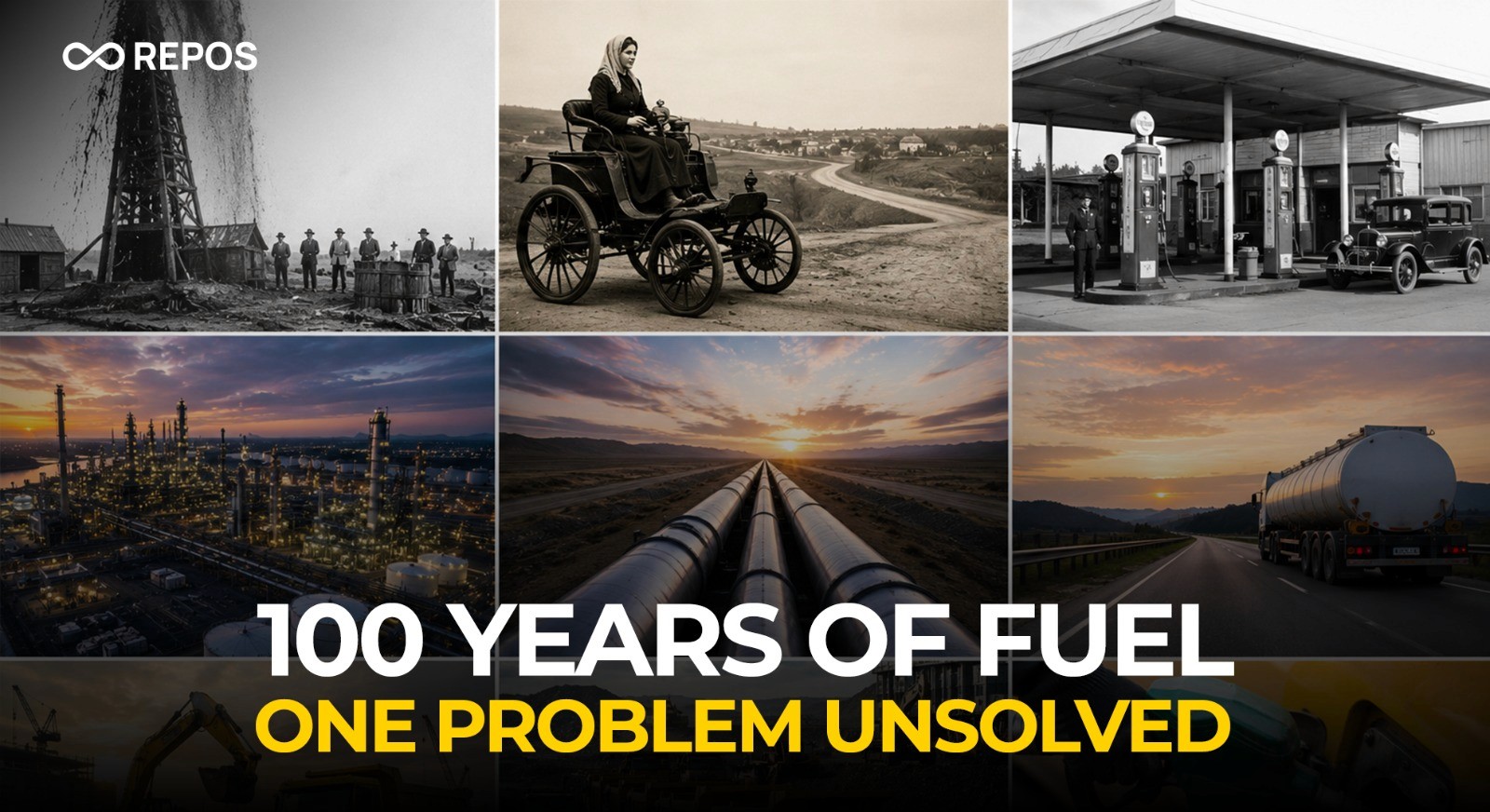
I put the paper down and started reading. One tab became ten. One hour became four. I went from the first oil well ever drilled, to supertankers crossing oceans, to a woman buying fuel from a pharmacy in 1888 because nobody had built a fuel station yet.
And somewhere in all of that, I found something I did not expect.
A problem that has existed for over a hundred years. That the smartest engineers, the biggest governments, and the largest energy companies in the world never actually fixed.
It started in 1859.
Oil came out of the ground in commercial quantities for the first time. The world got to work immediately. How to find more. How to move it faster. How to refine it better.
Over the next century, the global fuel supply chain became one of the most engineered systems ever built. Supertankers. Transcontinental pipelines. Satellite-tracked depots. Every litre accounted for. Every kilometre monitored.
Then the fuel entered a tank.
And the measurement stopped.
The first fuelling stop in history was a workaround.
In 1888, Bertha Benz drove 104 kilometres and ran out of fuel mid-journey. She walked into a pharmacy and bought what she needed off the shelf. Nobody had thought about what happens after the fuel is made.
Twenty-five years later, the first petrol station opened.
For over a hundred years after that, we kept adding more stations. We changed almost nothing else.
Here is what surprised me most.
India burns 33 crore litres of diesel every single day. Construction. Mining. Logistics. Power generation. These industries do not choose fuel as a preference. They run on it.
And yet, the moment fuel enters an operational tank at a site or inside a fleet, the data disappears. How much was used. How much was lost. What it actually cost. Nobody knows.
The machines are modern. The tracking is not.
The oil industry solved supply. Governments solved pricing. Refineries solved quality.
Nobody solved what happens inside the operation. That gap has been sitting there, quietly, for over a century.
I did not expect to find a problem this old, this large, and this unaddressed on a regular Sunday morning.
We at Repos made a film about exactly this. The full hundred-year story, told properly. I will not give it away here.
But if this made you pause even once, the film will make you think.
The world spent a century perfecting fuel. Here is what it forgot.